
West Indies Create ODI History with All-Spin Attack in Mirpur Thriller
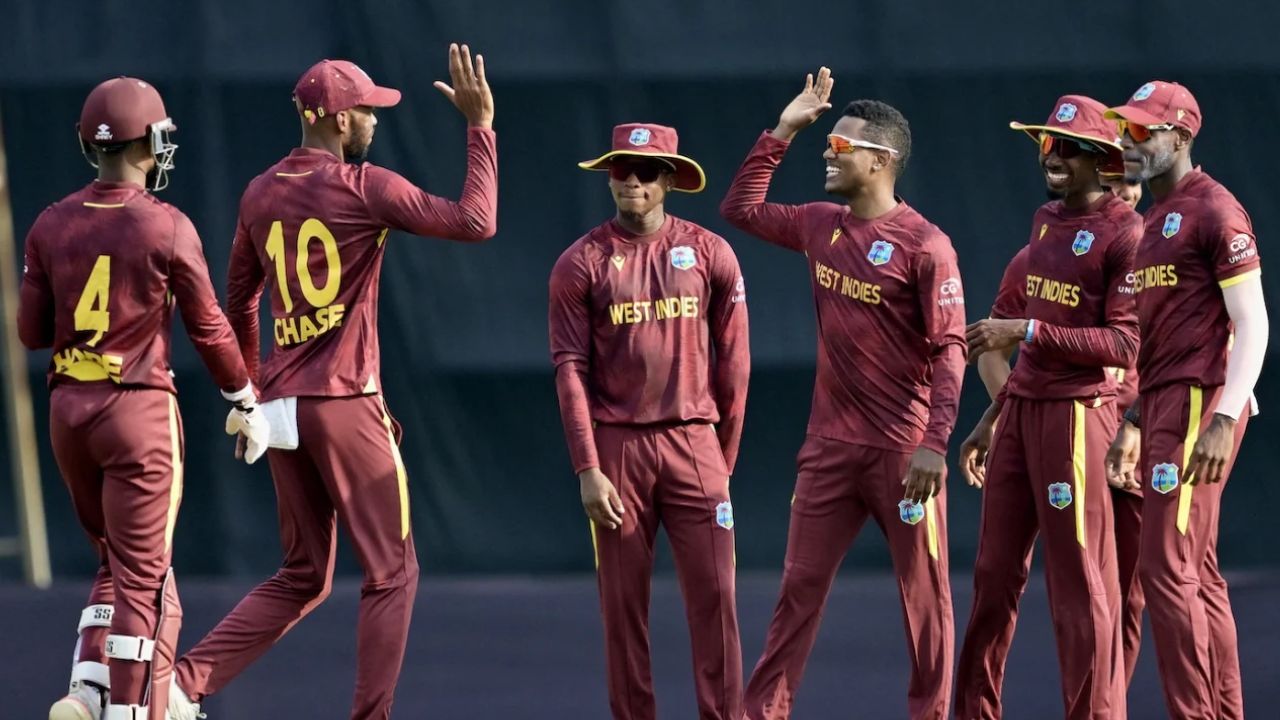
In one of the most unusual sights in modern cricket, the West Indies made history by becoming the first team ever (men’s or women’) to bowl an entire 50 over innings using only spinners.
The record-breaking moment came during the second One-Day International (ODI) against Bangladesh at the Shere Bangla National Stadium in Mirpur on October 21, 2025.
The visitors, traditionally famous for their fierce fast bowlers, fielded a lineup that relied entirely on spin. After losing the first match on a slow, turning surface, captain Shai Hope went all-in on spin for the second game.
Fast bowlers Jayden Seales and Romario Shepherd were dropped, and the West Indies brought in spinner Akeal Hosein and debutant batter Ackeem Auguste. The lone seamer in the playing eleven, Justin Greaves, was never called to bowl, not even for a single over.
Instead, Hope entrusted his full attack to five spinners ; Akeal Hosein, Roston Chase, Khary Pierre, Gudakesh Motie, and part-timer Alick Athanaze.
Each of them bowled their complete quota of 10 overs, making it the first instance in ODI history where 50 overs of spin were bowled in a single innings. The move paid off as Bangladesh were restricted to 213 for 7.
Left-arm spinner Gudakesh Motie was the pick of the bowlers, taking three wickets for 65 runs. Alick Athanaze, who had bowled just four overs across two ODIs before this match, produced a dream spell, 10 overs, three maidens, 14 runs, and two wickets.
Akeal Hosein claimed two for 41, while Chase and Pierre maintained control with tight lines. Together, the five spinners bowled 300 balls, conceding 207 runs and taking seven wickets, marking a tactical masterclass in adapting to conditions.
This feat broke Sri Lanka’s long-standing record of 44 spin overs bowled in an ODI, achieved three times, against the West Indies in 1996, New Zealand in 1998, and Australia in 2004. No other team, men’s or women’s, had ever managed a full 50 overs of spin in an innings before this match.
Bangladesh, known for their own spin-friendly pitches, found scoring difficult early on. Opener Soumya Sarkar’s 45 off 89 balls held the innings together after early wickets.
The middle order ,Najmul Hossain Shanto, Towhid Hridoy, and Nasum Ahmed, made brief contributions but couldn’t build a strong partnership. At 128 for 6, Bangladesh looked in deep trouble until Rishad Hossain’s stunning late surge changed the tempo.
Coming in at number nine, Rishad smashed 39 runs off just 14 balls, hitting three sixes and three fours in the closing overs to push the total past 200.
Chasing 214 on a deteriorating surface, West Indies also struggled against spin. Their innings mirrored Bangladesh’s, with wickets tumbling regularly.
Shai Hope’s unbeaten 53 anchored the chase, but the visitors slipped to 133 for 7, and the match seemed to be slipping away. In a tense finish, West Indies managed to tie the game at 213–9 after 50 overs, forcing a Super Over.
In the tiebreaker, West Indies batted first and scored eight runs. Akeal Hosein, who had earlier opened the bowling, was given the responsibility to defend it.
Despite starting the Super Over with a wide and a no-ball, he held his nerve and conceded only seven runs as Bangladesh fell short by one run, handing the visitors a dramatic victory.
The win not only levelled the three-match series 1–1 but also marked a new chapter in cricketing history. For a team that once boasted some of the fastest bowlers in the world, from Malcolm Marshall to Curtly Ambrose and Joel Garner, the West Indies’ full-spin strategy symbolized how much the modern game has evolved. The pitch in Mirpur, described as dry and dusty, turned out to be a perfect setting for this bold experiment.
Interestingly, before this match, West Indies had never bowled more than 34 overs of spin in an ODI innings. That made the leap to 50 overs even more remarkable.
For context, the world record for most overs of spin in a men’s ODI (across both innings) is 78.2, bowled by Afghanistan and Ireland in 2019. The corresponding record in women’s ODIs stands at 84 overs between Bangladesh and Pakistan in Dhaka — the same venue where this latest record unfolded.
This game may not have drawn big crowds, but it grabbed global headlines. In an era when the 50-over format struggles for relevance amid the growing focus on T20s and Tests, this match proved that ODIs can still surprise. The West Indies’ bold all-spin experiment, backed by smart captaincy and calm execution under pressure, turned a low-profile series into a piece of cricketing history.
Copyright © AMT Inc. All rights reserved 2024.