
NASA Ends Crew-11 Mission Early After Medical Issue, Astronauts Splash Down Near San Diego
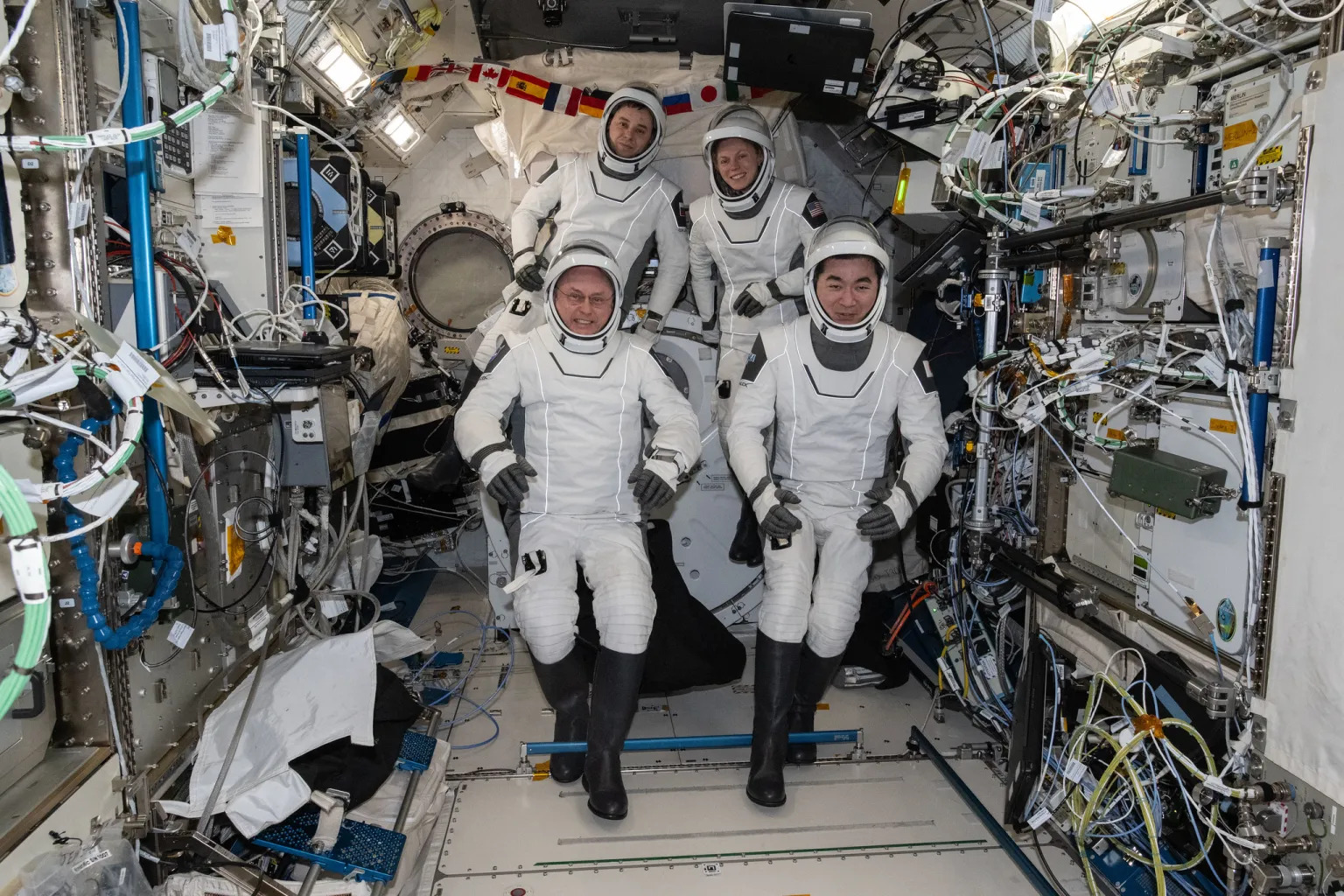
NASA’s SpaceX Crew-11 mission ended abruptly early Thursday as four astronauts splashed down in the Pacific Ocean near San Diego, marking the agency’s first-ever medical evacuation from the International Space Station and the first time in more than 25 years that a U.S. space mission was cut short for health reasons.
The SpaceX Dragon capsule touched down at 3:41 a.m. EST, less than 11 hours after undocking from the ISS, carrying NASA astronauts Zena Cardman and Mike Fincke, Japan’s Kimiya Yui, and Russian cosmonaut Oleg Platonov. One crew member developed a serious but stable medical condition earlier this month, prompting NASA to end the mission more than a month ahead of schedule.
“It’s so good to be home,” Cardman said after landing.
A cautious but unprecedented decision
NASA first acknowledged the issue on January 7, when a scheduled spacewalk by Cardman and Fincke was abruptly canceled due to what officials described as a “medical concern” involving one astronaut. The following day, the agency announced it would bring the entire Crew-11 team back to Earth to allow full medical evaluation on the ground.
“Yesterday, January 7th, a single crew member on board the station experienced a medical situation and is now stable,” NASA Administrator Jared Isaacman said during a news conference. After consultations with medical leadership, he added, “I’ve come to the decision that it’s in the best interest of our astronauts to return Crew-11 ahead of their planned departure.”
NASA has not disclosed the identity of the astronaut or the nature of the condition, citing strict medical privacy rules. Officials repeatedly stressed that the situation was not an emergency, but one that could be better assessed with Earth-based diagnostic tools.
“This was a deliberate decision to allow the right medical evaluations to happen on the ground, where the full range of diagnostic capability exists,” Fincke wrote in a social media post. “It’s the right call, even if it’s a bit bittersweet.”
Safe return under routine procedures
Despite the unusual circumstances, NASA said the return followed standard procedures. The Dragon capsule undocked from the station, as it flew about 260 miles south of Australia, before beginning a controlled descent through Earth’s atmosphere.
The spacecraft splashed down in calm conditions beneath parachutes, where recovery teams and flight surgeons were waiting. The astronauts were helped out of the capsule on reclining stretchers for routine post-flight checks and transported to a San Diego-area hospital for further evaluation.
“All crew members are currently undergoing the routine post-splashdown medical evaluation,” Isaacman told reporters. “The crew member of concern is doing fine. We will share updates on their health as soon as it’s appropriate to do so.”
He described the landing as a “successful and safe splashdown in pristine weather,” adding that the astronauts were “all safe and in good spirits.”
A mission cut short, but not incomplete
Crew-11 launched on August 1, 2025, aboard a Falcon 9 rocket from NASA’s Kennedy Space Center. Over 167 days in space, including 165 days aboard the ISS, the crew completed 2,672 orbits of Earth and traveled 70.8 million miles.
Their work included more than 850 hours of scientific research, ranging from lunar landing simulations and vision-protection studies to experiments on plant cells, stem cell production, and how viruses behave in microgravity.
“To be overwhelmingly clear, Crew-11 was a very successful mission,” Isaacman said. “While this was the first time we had to return crew slightly ahead of schedule, NASA was ready.”
“This is exactly why we train,” he added. “Spaceflight will always carry some degree of uncertainty. That is the nature of exploration.”
Impact on the space station
With Crew-11’s departure, the ISS is temporarily operating with just three people on board: NASA astronaut Christopher Williams and Russian cosmonauts Sergey Kud-Sverchkov and Sergey Mikayev, who arrived in November aboard a Soyuz spacecraft.
The reduced crew means fewer experiments and limited maintenance, and NASA has said it will be unable to conduct spacewalks — even in an emergency — until the next crew arrives.
SpaceX’s Crew-12 mission, carrying two Americans, one European, and one Russian astronaut, is currently scheduled to launch no earlier than mid-February, though NASA and SpaceX are exploring options to move that date up slightly.
Despite the disruption, officials emphasized that the station remains safe and operational, and that contingency planning — including international seat-swap agreements between NASA and Russia — ensured continuous coverage of all ISS systems.
As Isaacman put it, the early return of Crew-11 was not a failure, but a test of preparedness. “NASA prepares for the unexpected,” he said, “so we are ready to respond decisively and safely.”
Copyright © AMT Inc. All rights reserved 2024.